
Dense material only
Concrete & Heavy Debris Dumpsters Holland MI
Concrete, block, brick, dirt and stone go in a small box filled part way. Dense material breaks every instinct you have about dumpster size, and here is the arithmetic behind that.
- Licensed & insured
- Same-day delivery
- Flat-rate pricing
- Locally owned
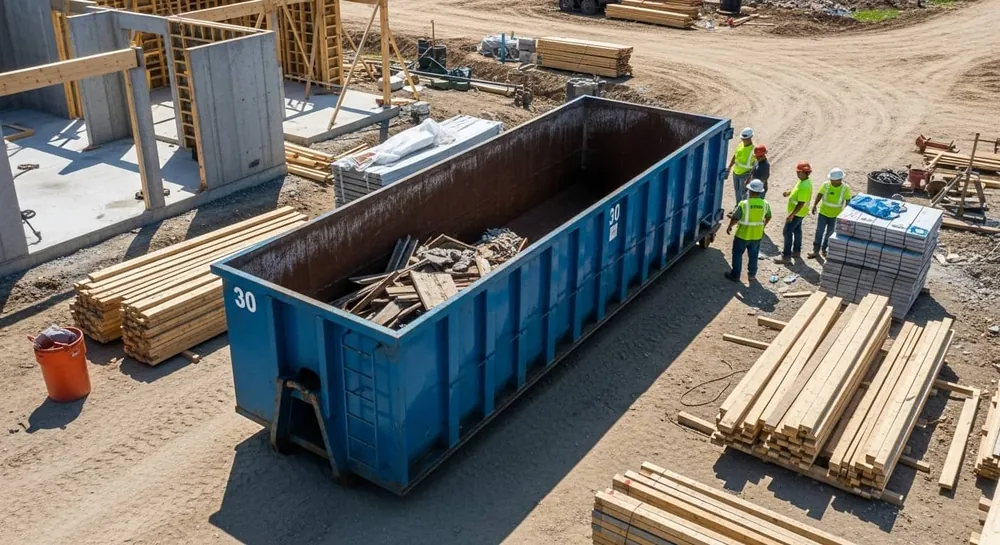
Concrete & Heavy Debris Dumpsters Holland MI across Holland and Ottawa County
One cubic yard of broken concrete weighs something in the region of two tons. Read that again before you order a 30 yard for a driveway tear-out. Dense material is the one category where everything people know about dumpsters stops working, because the box will be legally and physically full while it still looks two thirds empty, and no amount of arguing with the driver changes what the truck can lift off the ground.
So we run these jobs differently. A dedicated heavy container, a marked fill line, clean material only, and a conversation on the phone about how many square feet of slab you are actually pulling up. Driveway removals, patio and sidewalk tear-outs, block foundations, brick, stone, dirt and sand from an excavation. Common work around here, and the freeze-thaw cycle keeps supplying it.
Why dense material breaks every intuition
Volume is the wrong unit for this job. Weight is the only one that matters, and these rules of thumb are close enough to plan on.
- Broken concrete — roughly two tons per cubic yard
- Brick and block — a little lighter, but not enough to change your decision
- Soil and clay — heavier still when wet, and Michigan clay holds water like a sponge
- A 4-inch slab — figure roughly 1.5 to 2 tons per 100 square feet, more if it was poured thick or has wire and rebar through it
Run that on a two-car driveway of around 600 square feet and you are into serious tonnage before you touch the apron. Which is why the answer is never one big box. The cost guide shows how overage works when a load goes past its allowance.
The 10 yard, and the line you fill to
The 10 yard exists for this. Short, low-sided, easy to load over the rail with a wheelbarrow, and small enough that a full one is still haulable. It fits on a single-width drive, which matters because most of these jobs are at houses.
You will not fill it to the top and that is by design. We mark a fill line and we mean it. A heavy box loaded above that line cannot be legally transported and the driver will not take it, which turns into a wasted trip and a second call. Load it level, spread the material rather than piling it at one end, and keep the door end loadable.
For bigger removals the answer is multiple hauls of a small box rather than one large container. Two 10 yard pulls beat a 30 yard you are not allowed to fill. If the demolition also produces wood and drywall, that belongs in a separate demolition debris container.
Clean loads, recovery value, and a tired driveway
Clean concrete has somewhere to go other than a landfill. Crushed and graded it becomes aggregate, which is why keeping it uncontaminated is worth real effort. Clean means concrete, block, brick and stone — no wood, no drywall, no plastic sheeting, no rebar tangled through it in quantity, no dirt mixed in if you can help it. One load of mixed rubbish in with the slab and the whole container loses that route.
Placement deserves a thought too. The driveway you are about to demolish is often the one the container has to sit on, and if it is already cracked from freeze-thaw it will not improve under several tons of its own remains. Boards go under the rails as standard, and if the concrete is genuinely failing we would rather set the box on a gravel pad, the street apron or the lawn edge and talk it through first.
Sizes
Which container for concrete & heavy debris?
Every service runs in all four sizes. Match the material to the weight allowance and the rest takes care of itself.
| Size | Dimensions | Capacity | Weight included | Best for |
|---|---|---|---|---|
| 10 Yard Dumpster | 12 ft long × 8 ft wide × 3.5 ft high | about 3 pickup truck loads | 1–2 tons | Small bathroom remodels, single-room cleanouts, concrete and heavy debris, roofing up to about 15 squares. |
| 15 Yard Dumpster | 16 ft long × 8 ft wide × 4 ft high | about 4–5 pickup truck loads | 2–3 tons | Garage and basement cleanouts, kitchen remodels, medium roof tear-offs, small deck removals. |
| 20 Yard Dumpster | 22 ft long × 8 ft wide × 4.5 ft high | about 6 pickup truck loads | 3–4 tons | Whole-home decluttering, flooring and siding jobs, large tear-offs, drywall and mud phases. |
| 30 Yard Dumpster | 22 ft long × 8 ft wide × 6 ft high | about 9 pickup truck loads | 4–5 tons | Full-house renovations, new construction, estate clearances, commercial fit-outs and demolition. |
| 40 Yard Dumpster | 22 ft long × 8 ft wide × 8 ft high | about 12 pickup truck loads | 5–6 tons | Large commercial fit-outs, industrial clear-outs, major renovations and high-volume light debris. |
Talk to a real person
Need concrete & heavy debris in Holland?
Call (616) 499-6026 and describe the job. You will get a flat price and a delivery time on the same call — most orders before noon go out the same day.
Mon–Sat 7:00am – 6:00pm · Sun by appointment
Answers
Concrete & Heavy Debris — your questions
How much concrete fits in a 10 yard dumpster?
Far less than ten yards, because weight runs out first. Broken concrete runs around two tons per cubic yard, so a heavy container is at its legal haul limit well before it looks full. Expect to load to a marked fill line rather than the rails. For a typical two-car driveway, plan on more than one pull.
Why can I not put concrete in a 30 or 40 yard container?
Because the truck cannot lift it and the road cannot legally carry it. Filling a 30 yard with concrete would put the loaded weight far beyond what a roll-off truck is permitted to haul. The large boxes exist for light bulky material like siding, insulation and furniture. Dense material always goes in a small container filled part way.
What counts as a clean concrete load?
Concrete, block, brick and stone with nothing else in it. No wood, no drywall, no plastic, no roofing, no soil if you can avoid it, and no heavy tangles of rebar. Clean material can be crushed into aggregate rather than landfilled, which is worth the effort of separating it. Mixed loads lose that route entirely and are handled as general debris.
Can I put dirt and sod in the same container?
Dirt yes, sod no. Soil is handled as heavy debris and follows the same fill-line rules as concrete, and Michigan clay gets dramatically heavier once it is saturated. Sod counts as yard waste, which Michigan bans from landfill, so it has to go in a separate green load. Tell us on the phone which you actually have.
Will a heavy container crack my driveway?
It is a fair worry, particularly on older concrete that has already been opened up by freeze-thaw. Boards go under the rails on every driveway placement to spread the load, and the smaller heavy box has a shorter footprint than a big container. If the surface is genuinely failing, tell us and we will look at a gravel pad or the apron instead.
Service area
Concrete & Heavy Debris across the Lakeshore
We run roll-off dumpsters out of our 460 Cleveland Ave yard across Ottawa County and Allegan County — from the cottage lanes at Macatawa and Saugatuck to the farm drives around Overisel and Hamilton, and north up US-31 as far as Grand Haven. If your town is not on this list, call us anyway. We probably still get there.