

Estate Cleanout Checklist for Holland, MI Families
A practical, unhurried order of work for clearing a family home in Holland and across the Lakeshore, from legal authority and searching through to sizing and pace.
ReadHolland, MI guide
A West Michigan contractor's guide to sizing, sequencing and loading construction debris containers by build phase so you stop paying for air or blowing tonnage.
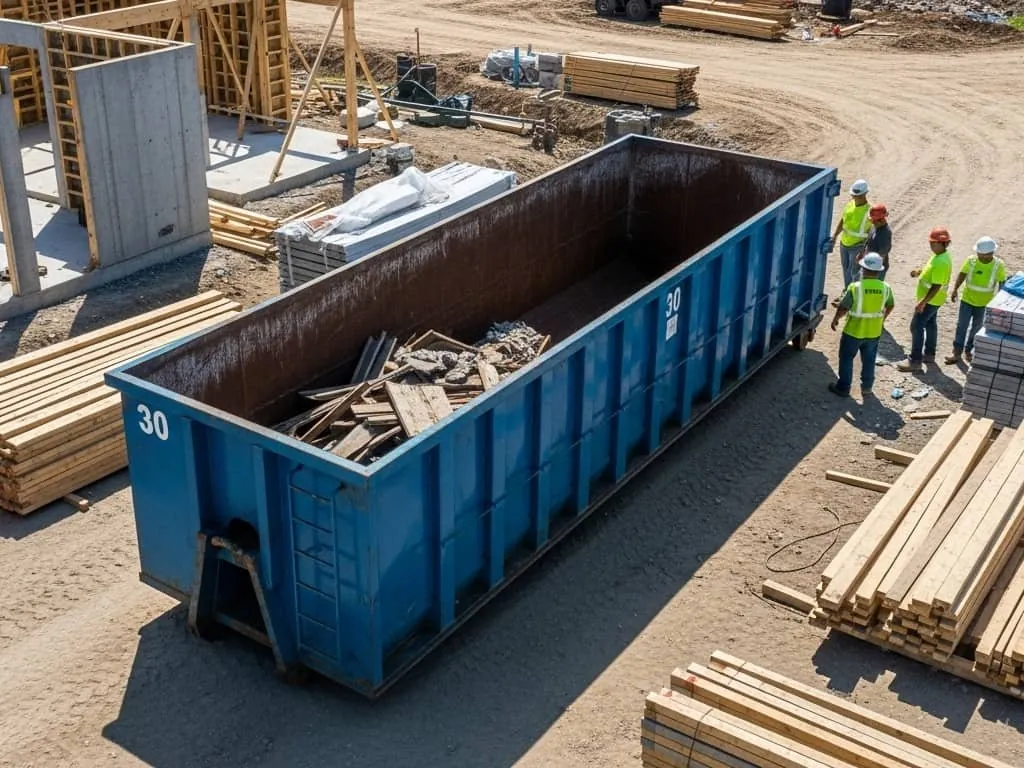
A garage cleanout is a volume job. You fill the box with couches and cardboard, it goes out light, and nobody thinks about the scale ticket. A jobsite is the opposite. Every container we run has a tonnage allowance attached to it, and on most phases of a build you will hit that number long before the walls of the can are full. That is the single most expensive misunderstanding we see on the Lakeshore, and it costs contractors real money every season.
Rough numbers help. Mixed construction and demolition debris tends to land somewhere around 300 to 500 pounds per cubic yard once it is loaded and settled — treat that as a rule of thumb, not gospel, because the mix drives everything. Framing offcuts and cabinet boxes might run half that. A third of a yard of chimney brick will run five or six times that. Fill a 30 yard box to the rail with clean framing scrap and you are in normal territory. Put a mortar bed, a cast iron tub and three courses of block in the front third of that same box and you are over allowance with twenty yards of empty air above it.
The fix is not a bigger container. It is matching the box to the phase, sorting the heavy streams out before they ever go over the rail, and telling your hauler what you expect to generate so swaps get scheduled instead of improvised. Everything below is how we approach it on construction debris jobs from downtown Holland to the dune lots in Park Township.
Contractors ask us to size for "a 2,400 square foot remodel." That number tells us almost nothing. Sizing for the job as a whole means picking one container that is wrong for most of the schedule. Sizing by phase means the box on site is right for what the crew is actually throwing in it that week.
Tear-out and rough framing produce bulk. Cabinets, subfloor, studs, sheathing, jobsite offcuts, packaging — it is airy, it bridges, it does not compact well. This is where a 30 yard roll-off or a 40 yard earns its keep, because you are buying cubic capacity and you are unlikely to bury the tonnage allowance with wood. The exception is older Holland housing stock. Pull plaster and lath out of a near-downtown 1920s home and you are running a demolition phase at drywall densities. Size accordingly, or split it: heavy plaster in a smaller box, framing and bulk in the big one.
This is where crews get caught. Board scrap, mud buckets, mortar, thinset and tile are dense and they load flat with no air in them. A 20 yard container is usually the right call here — not because you cannot fill a 30, but because you will hit the weight allowance at roughly two-thirds fill in the bigger box and then you are paying rent on capacity you legally cannot use. A 20 yard that gets swapped twice beats a 30 that sits half loaded and overweight.
Trim, doors, flooring offcuts, packaging, fixture cartons. Low weight, steady trickle, and it goes on for weeks. A 10 or 15 yard box is plenty, and it takes far less of your staging area during the phase when deliveries and subs are heaviest. See the full size range if you want dimensions before you plan the drive or the lay-down area.
Staging two or three containers across a build almost always costs less than parking one 40 yard box for eight weeks. You pay for the days you actually need the capacity, the driveway is clear during the phases you need it clear, and you never carry a half-full box through a stretch where nothing is coming out of the building.
These are field approximations for planning. Actual weights vary with moisture, age and how much mortar or fastener is still attached.
| Material | Rough weight (rule of thumb) | How it loads | Container that suits |
|---|---|---|---|
| Plaster and wood lath (pre-1950 Holland homes) | Several times modern drywall by volume; very dense | Compacts flat, no air, dusty | 20 yard, loaded low |
| Modern gypsum board and mud | Roughly 500-700 lb per cubic yard loaded | Stacks tight, absorbs water fast | 20 yard |
| Asphalt shingle tear-off | Roughly 230-250 lb per square (three-tab); more for architectural or double layer | Dense, heavy, uneven | 10-15 yard, dedicated load |
| Concrete, brick, block, mortar | Roughly 2,000-4,000 lb per cubic yard | Loads to a few feet only | 10 yard heavy-debris box |
| Soil, sand, dune subgrade spoil | Roughly 2,000-2,700 lb per cubic yard, more when wet | Shifts, holds water | 10 yard heavy-debris box |
| Ceramic and porcelain tile with thinset | Comparable to light masonry | Fills the floor of the can fast | 10-20 yard |
| Old-growth dimensional framing | Noticeably denser than modern SPF; true 2x dimensions add volume too | Long pieces bridge and waste space | 30 yard, cut down |
| Modern framing, OSB, sheathing | Roughly 250-400 lb per cubic yard dry | Airy, bridges badly | 30-40 yard |
| Carpet, pad, fibreglass insulation | Very light dry, several times that wet | Springs back, needs stacking | 30 yard |
| Scrap metal, ductwork, cast iron | Heavy, but recoverable value | Awkward, punctures other loads | Pull separately |
| Land-clearing brush and stumps | Heavy green, heavier wet | Bridges severely | Separate green-waste load |
Load level with the top rail. Not a foot over, not a heaped pyramid with a bathtub on top. A container that cannot be tarped cannot be legally hauled, and our driver will not take it. That is a dry run, a lost slot on the schedule and a crew standing around a full box the next morning. Break down cabinet carcasses, cut long framing, and put flat material flat. Most crews get 20 to 30 percent more into the same can just by loading it deliberately instead of throwing.
Keep heavy inert material out of your mixed load. Concrete, brick, block, mortar rubble, tile and dirt belong in a dedicated heavy-debris container — partly because the weight maths does not work otherwise, and partly because a mixed C&D load contaminated with rubble can be rejected outright at the receiving facility. Same logic for shingles: a tear-off wants to be its own clean load, which is covered in more detail in our roofing tear-off sizing guide. Pull ductwork, copper, cast iron and structural steel for scrap recovery before they get buried under drywall.
Two state-level realities drive sorting here. First, Michigan's landfill ban on yard clippings means land-clearing green waste — brush, limbs, sod, stumps — stays out of your C&D box and goes on a separate green waste haul. Mixing it in can turn a routine load into a rejected one.
Second, asbestos. Any structure built before 1980 needs an assessment before anything gets broken up: floor tile and mastic, pipe and boiler lagging, textured ceilings, siding, some plaster systems and joint compounds. Asbestos-containing material is prohibited in any container we place, and removal is licensed abatement work with its own notification requirements. Get the survey done before demo starts, not after a sub has dry-cut a room. The Michigan EGLE and EPA asbestos pages are the right starting points. Our what can and cannot go in a dumpster rundown covers the rest of the prohibited list.
An open container on the Lakeshore is a rain gauge. Drywall, insulation, carpet, pad and untreated timber all drink, and a box that was comfortably inside allowance on Friday can be several hundred pounds heavier by Monday. Tarp before a forecast — every time, not when you remember. Winter is worse: wet lake-effect snow sitting on an open load is genuine tonnage, and it is tonnage you paid to haul and got nothing for.
Then there is spring. Seasonal weight restrictions on posted county roads — frost laws, roughly late winter into spring depending on the thaw — limit how much weight a loaded truck can legally carry. That affects the lakeshore and rural routes around Hamilton, Overisel and Fennville more than it does in-town Holland. Practically, it means a smaller container swapped more often is sometimes the only workable answer in April. Plan the demolition-heavy phases outside that window if the schedule allows, and tell us early if it does not.
The most expensive thing on any jobsite is a crew waiting on a full box. Give us your expected fill rate at the start — how many yards a week, which phase produces it, what day the drywall lands — and swaps get scheduled ahead instead of called in as an emergency. We run same-day delivery and swap-outs across Ottawa and northern Allegan County, but a planned swap beats a rushed one every time.
Contractor accounts exist for builders running more than one site. Priority swap scheduling, consistent flat-rate pricing regardless of which address you are working, certificates of insurance on file so you are not chasing paperwork at every pre-con, and consolidated invoicing instead of a receipt per haul. Service coverage by community is listed on our service area page, from Zeeland and Hudsonville out to Saugatuck, Douglas, Grand Haven and Coopersville.
Tell us the phase, the material and the schedule, and we will size the container to the work rather than the guess. Call the yard at (616) 499-6026 to set up delivery, book a swap or open a contractor account.
Talk to a real person
Call and describe the job. Flat price, stated tonnage, and a delivery time on the same call.
Mon–Sat 7:00am – 6:00pm · Sun by appointment
From this guide
There is rarely one right answer for a whole build. Demolition and framing suit a 30 or 40 yard because the debris is bulky and light. Drywall, mud, tile and masonry suit a 20 yard because weight, not volume, limits the load. Finish and trim-out runs fine in a 10 or 15 yard. Staging containers by phase usually costs less than one big box for the duration.
Two reasons. Weight is the first: concrete and brick run roughly 2,000 to 4,000 pounds per cubic yard, so a few feet of rubble will exceed the tonnage allowance on a mixed container. The second is disposal. Receiving facilities handle clean inert material differently from mixed C&D, and rubble mixed into a general load can get that load rejected. Book a dedicated heavy-debris container.
Plaster and wood lath weighs several times what modern gypsum board does for the same volume, and it compacts flat with no air in it. Gutting a pre-war home near downtown Holland is effectively a heavy-debris phase, not a bulk phase. Plan a 20 yard loaded low rather than a 30 you cannot legally fill, and get an asbestos assessment done first.
Yes, and before the forecast rather than after. Drywall, insulation, carpet, pad and untreated lumber all absorb water, and a soaked load can gain hundreds of pounds you paid to haul. Winter snow sitting on an open box is the same problem in a heavier form. Loads must also be level with the top rail to be tarped and hauled legally.
Seasonal weight restrictions on posted roads limit how much weight a loaded truck can legally carry during the spring thaw. On rural and lakeshore routes that can mean we cannot pull a fully loaded large container the way we would in July. The practical workaround is a smaller box swapped more frequently. Tell us your spring schedule early so we can plan the rotation.
Keep reading
A practical, unhurried order of work for clearing a family home in Holland and across the Lakeshore, from legal authority and searching through to sizing and pace.
ReadShingles are the densest load a roll-off carries. Here is how to size a tear-off container in Holland by squares and layers instead of guessing big.
ReadDriveway damage from a roll-off happens in two moments, not two weeks. How the load works, what boards prevent, and the best season to book in West Michigan.
Read