Construction Debris Dumpster Guide for Holland, MI Jobs
A West Michigan contractor's guide to sizing, sequencing and loading construction debris containers by build phase so you stop paying for air or blowing tonnage.
ReadHolland, MI guide
Roll-off containers run all winter on the Lakeshore. What changes in snow and ice, why frozen ground helps, and how to plan around the spring thaw.
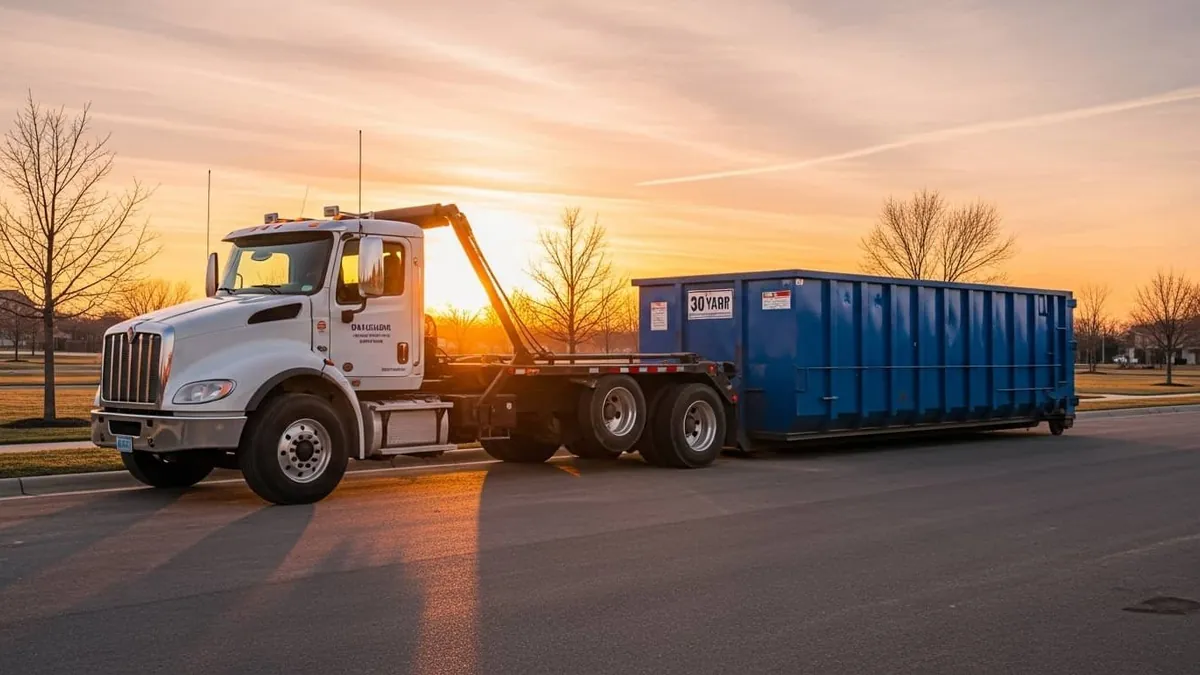
Every winter, right after the first real lake-effect event — the one that buries Park Township under a foot while Hudsonville gets a dusting — the phone starts ringing with the same question. Do you still run dumpsters in this? Yes. We deliver and haul roll-offs every week of a West Michigan winter. Trucks are out the morning after a storm.
What changes is the site, not the service. Snow, ice and frost rearrange the physics of getting a loaded truck up a driveway and setting a box exactly where you want it. Nearly every winter delivery that goes sideways does so for a reason the customer could have fixed in twenty minutes with a shovel.
And here is what people do not expect: winter is often the better season to rent. Frozen ground carries weight. Schedules are quieter and availability is better. The genuinely hard window on the Lakeshore is not January — it is the thaw, roughly March into May, when frost laws go up on the county roads and the subgrade under your drive turns to pudding. Understand that one fact and you can plan a year of projects around it.
This is the number one cause of failed winter deliveries, and it is entirely preventable. A roll-off truck sets a container by backing in, tilting the bed and rolling the box down onto the surface. It cannot do that on eight inches of unploughed snow. The box slides, sets crooked, finishes two feet off target — and when the melt comes you find it half on your lawn.
Clear the whole footprint, not just a path to it. A 20-yard container wants roughly 22 feet of length plus 15 to 20 feet in front for the truck to work — call it 60 feet of run, 10 to 12 feet wide. Get down to pavement: packed snow under the rails is a lubricant.
Then think about where the snow goes. The plough guy windrows everything into a berm along the edge of the drive, and that berm sits exactly where the container was supposed to sit. City and county ploughs also throw a dense ridge across your apron at the kerb every pass, and that ridge stops a truck cold. Push snow to the far side or the back, keep the apron open, and hit it again the morning of delivery.
Downtown Holland is the happy exception. The snowmelt system under the sidewalks and several downtown streets keeps the core bare while everything three blocks out is white. For a fit-out or an apartment cleanout downtown, February placement is often easier than in the neighbourhoods.
A loaded roll-off truck is heavy, and what carries that load is not the asphalt — it is the subgrade underneath. In January that subgrade is frozen solid and behaves like a slab. In April it is saturated meltwater sitting on a layer that is still frozen and will not drain, and it behaves like wet clay.
So a placement on a gravel drive near Overisel or Graafschap goes perfectly in mid-January and ruts six inches deep in the same spot in mid-April. Frozen is firm. If you have a long unpaved drive, winter is the safer window. We still put boards under the rails as standard — see our notes on protecting your driveway.
Snow is a logistics problem. Ice is a safety problem, and it is the one we lose sleep over.
Three risks. The driver works around a moving cable and a tilting bed on a surface that may be glazed. That is how people get hurt. You then carry awkward loads out to that container dozens of times, often in the dark, because in January it is night by five. And the surface underneath is hidden: if the box sets on a sheet of ice, nobody knows what shape the concrete is in until spring.
Salt or sand the working path before delivery and top it up as work goes on. Sand beats salt for traction once ice is hard. Watch the freeze-thaw cycle too, because this shoreline does it relentlessly — melt in the afternoon sun, refreeze overnight, and a drive that was clear at four is wearing black ice by seven. That cycle is what quietly destroys concrete here.
Here is the one that catches people out every year. An open container sitting through a heavy lake-effect band collects a remarkable amount of snow, and snow is not weightless. The wet, dense stuff off the lake weighs far more than the powder they get inland, and an open box is a large flat target.
Worse, the debris already inside acts like a sponge. Drywall, insulation, carpet, cardboard and untreated timber all drink up meltwater and hold it. Then it refreezes. You end up paying for weight that fell out of the sky. It is the winter version of leaving the box open through an October downpour, and it happens more often, because snow keeps arriving after you have gone inside for the night.
Five minutes with a tarp is the cheapest weight management on any winter job. Weight the edges — the wind off Lake Michigan will take an unsecured tarp to the next county.
The second half of the same problem shows up at the tipping face. Debris rained on and then frozen becomes one solid mass keyed into the container walls, and it does not always come out when the box is tipped. Load tight and flat, break bulky items down rather than tossing them in whole, and keep water from pooling in the bottom. A tightly loaded container beats a loosely tossed one.
Roofs get torn off here in February. Not by choice, but because when ice damming is driving water into a ceiling the repair cannot wait for April. Two things matter: the snow around the drop zone has to be moved before the truck arrives, and the box still needs to sit tight to the eave so tear-off lands in steel rather than the shrubs. See roofing debris containers for sizing.
Frost laws are seasonal weight restrictions posted by county road commissions — Ottawa and Allegan both do it — as frost comes out of the ground in spring. The mechanism is simple. Water in the subgrade freezes over winter and stays locked up. It thaws from the top down, so the meltwater is trapped above a layer that is still frozen and has nowhere to drain. The surface looks identical; underneath, the support has gone. Run heavy axle loads over it and you break the road.
Commissions post restrictions somewhere in the March-to-May range depending on the year and lift them as conditions recover. They are not on a fixed calendar: a mild February puts them up early, a long cold spring pushes them late. Always check your county road commission for current restrictions rather than assuming last year’s dates.
None of this is a reason to avoid spring work. It is a reason to plan it. If you have a demolition or construction debris job with real tonnage in it, book it before restrictions post or push it past the lift. Our guides to choosing a container size and what a rental costs here will help.
| Season | Ground and access | Main risk | What to do about it |
|---|---|---|---|
| Autumn (Sep–Nov) | Firm and dry; full access | Late rain adding weight to absorbent debris | Best all-round window. Book heavy projects here and tarp if rain threatens |
| Deep winter (Dec–Feb) | Frozen subgrade carries weight; snow and ice block access | Snow load adding tonnage; ice underfoot and under the box | Clear the footprint to pavement, sand the path, tarp between sessions. Quieter schedules |
| Spring thaw (Mar–May) | Saturated, unsupported subgrade; frost laws posted | Restricted hauling, delayed pickups, rutted drives | Hardest window. Plan around postings, consider a smaller box swapped more often |
| Summer (Jun–Aug) | Firm and dry, but asphalt softens in heat | Rails marking hot driveways; peak demand | Boards under the rails, avoid soft afternoon asphalt, book ahead |
The pattern is clear. Autumn is easiest. Deep winter is workable and quieter, so you usually get the day you want. Spring thaw is the one to plan around.
EAD Dumpster Rentals is locally owned, licensed and insured, running year-round out of Holland with flat-rate pricing and driveway-safe placement across Ottawa and Allegan counties — see our full service area. Tell us what the drive looks like and what you are throwing out, and we will tell you straight whether to go now or wait out the thaw. Call (616) 499-6026.
Talk to a real person
Call and describe the job. Flat price, stated tonnage, and a delivery time on the same call.
Mon–Sat 7:00am – 6:00pm · Sun by appointment
From this guide
Yes. We run roll-off containers every week of the year, including the days after a heavy lake-effect snowfall. The only thing that stops a winter delivery is the site itself. If the driveway is unploughed or a plough berm blocks the apron at the kerb, the truck cannot set the box safely and we have to reschedule. Clear the footprint down to pavement and we can work.
Clear the container footprint plus room for the truck to work. For a 20-yard box, plan on roughly 60 feet of cleared run and 10 to 12 feet of width, taken down to the pavement rather than packed snow. Push the snow to the far side or the back of the drive, never into the placement spot, and re-clear the kerb apron the morning of delivery.
Frost laws are seasonal weight restrictions posted by county road commissions as frost leaves the ground in spring, typically somewhere between March and May depending on the weather. Thawing subgrade cannot support heavy axle loads, so posted roads limit what a loaded truck can haul. That may mean an earlier pickup, a later one, or a smaller container swapped more often. Check your county road commission for current restrictions.
It can, and it surprises people. Wet lakeshore snow is heavy, and an open container presents a large surface area to catch it. Absorbent debris like drywall, insulation, carpet and cardboard soaks up meltwater and holds it, then refreezes. Tarping the box between working sessions takes about five minutes and keeps you from paying for weight that fell out of the sky.
Winter is usually better than spring on the Lakeshore. Frozen ground supports a loaded truck far better than saturated thaw-season subgrade, schedules are quieter, and availability is stronger. The spring thaw brings soft drives, rutting on gravel and frost law restrictions on county roads. If your project is heavy, do it in autumn or deep winter, or wait until restrictions lift.
Keep reading
A West Michigan contractor's guide to sizing, sequencing and loading construction debris containers by build phase so you stop paying for air or blowing tonnage.
ReadA practical, unhurried order of work for clearing a family home in Holland and across the Lakeshore, from legal authority and searching through to sizing and pace.
ReadShingles are the densest load a roll-off carries. Here is how to size a tear-off container in Holland by squares and layers instead of guessing big.
Read